
Rain Bonnets

It rained this morning.
Water, or lack thereof, changes everything in an ecosystem. It’s the currency of life in nature. In the desert, plants and animals hoard water like dragons atop heaps of gold and gems. For a cactus or a tortoise it’s a matter of life and death, and surrendering any of your accumulated wealth is usually death. Sea urchins, on the other hand, live in such abundance that they forgo muscles and use precious water as a hydraulic system to get around. Temperate forests lie in between. You can spend frivolously today because you know there’s always another paycheck coming, eventually. Things might get sketchy, but it’s coming. And so it is for the bonnet mushrooms on the trunk of an ancient serviceberry.
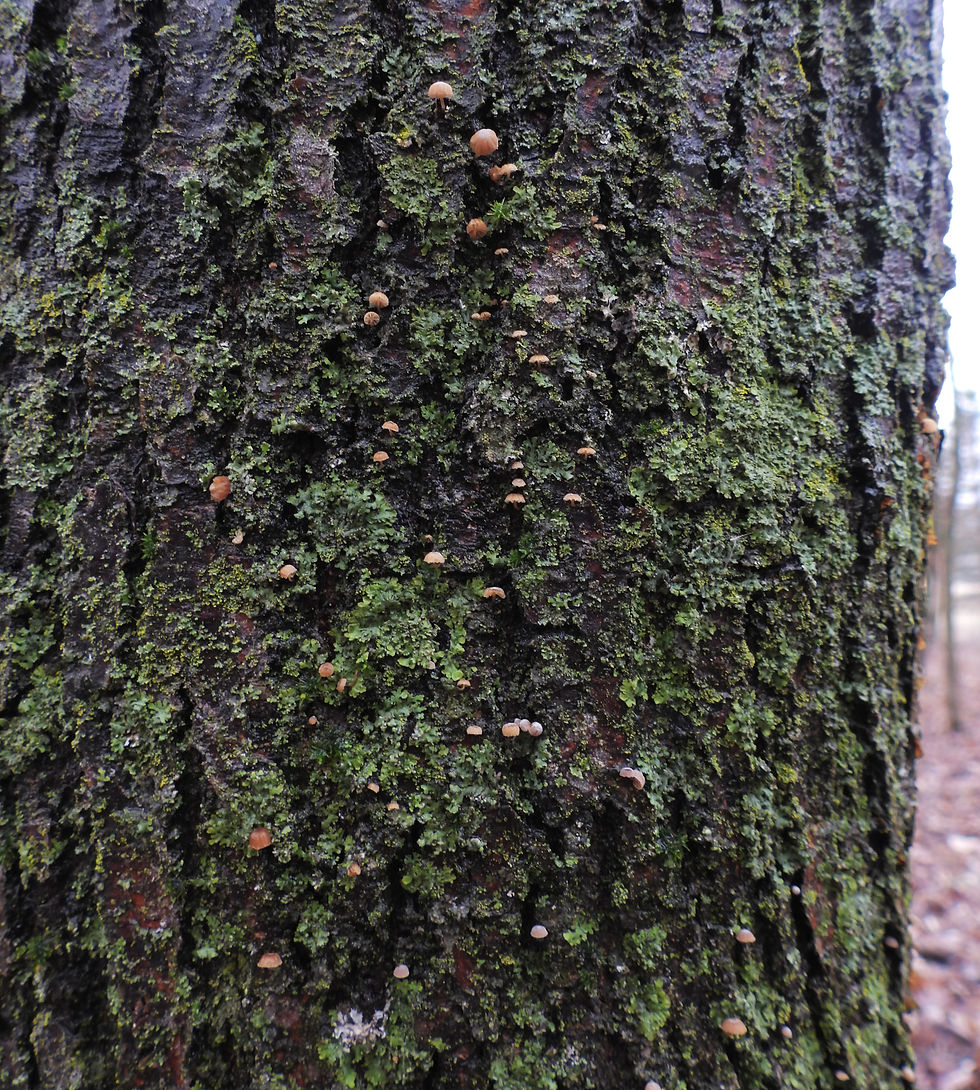
I say ancient, because this tree is old by serviceberry standards. 15 meters tall and likely over half a century into its life, it’s a kid by the standards of the nearby oaks, but a mature and declining tree as a serviceberry goes. Its bark is rough and weathered in spots, caked with lichens and moss that greens up like emerald velvet after a rain. And so it was that I stopped to check on the miniature forest on the trunk after the morning downpour and saw that the landscape had sprouted hundreds of miniscule mocha mushrooms. By miniscule, I mean that the naked eye could barely discern what they were. Twenty of these things could sit on a penny without covering it.
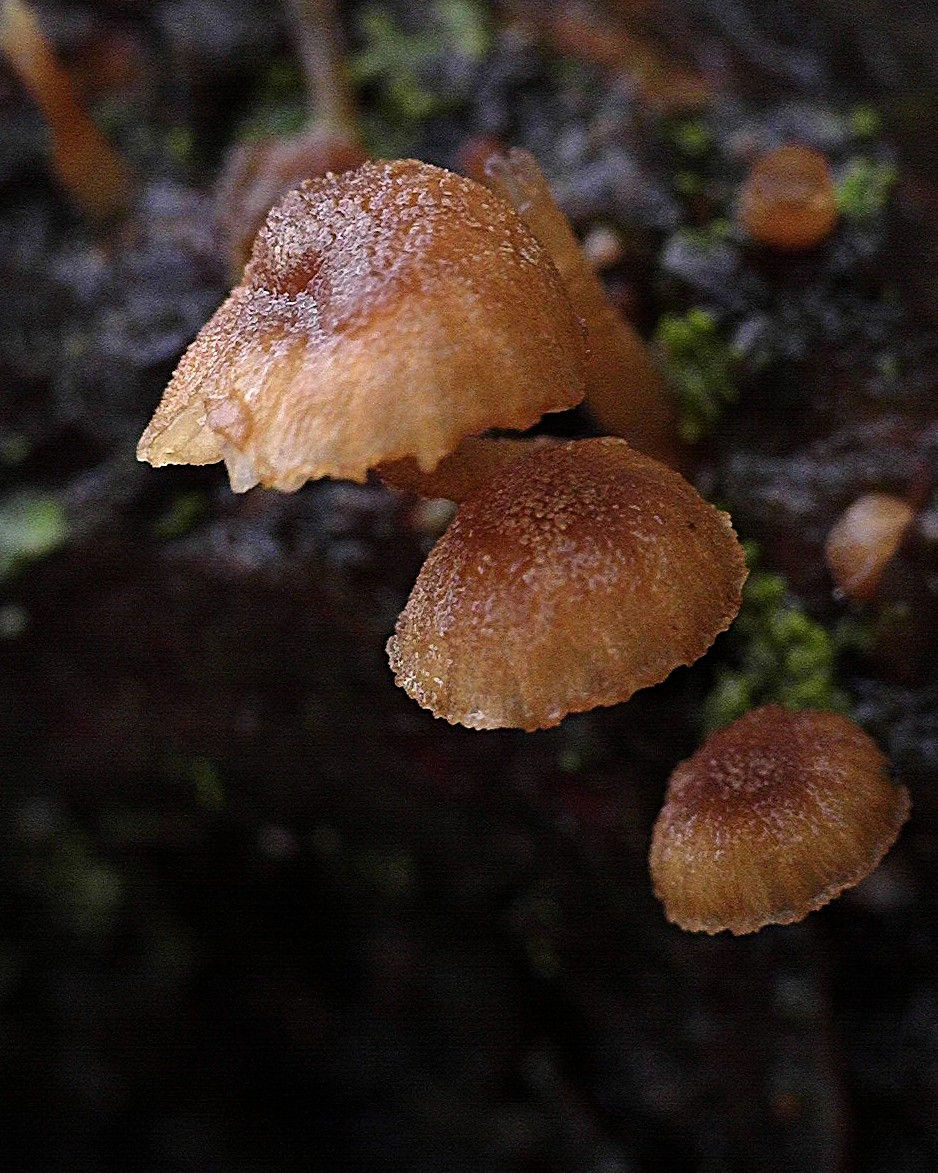
Bark Mycena (Mycena corticola) is a fungus in the Mycenaceae family. Mycenaceae has about 700 species of small mushrooms called “bonnets” which are mostly saprotrophic, meaning they consume dead material and do not parasitize living tissue. I’ve seen some conjecture that Mycena corticola is a species complex more than a true species. This means it could be several species that are so similar genetically and morphologically, they’re difficult to separate. I’m not here to argue for or against that, especially since it touches on what the definition of “species” really is. If you put five biologists in a room, you’ll hear at least twelve different concepts of what a species is. That’s a tale for another time. Today, let’s just presume these are Bark Mycena.
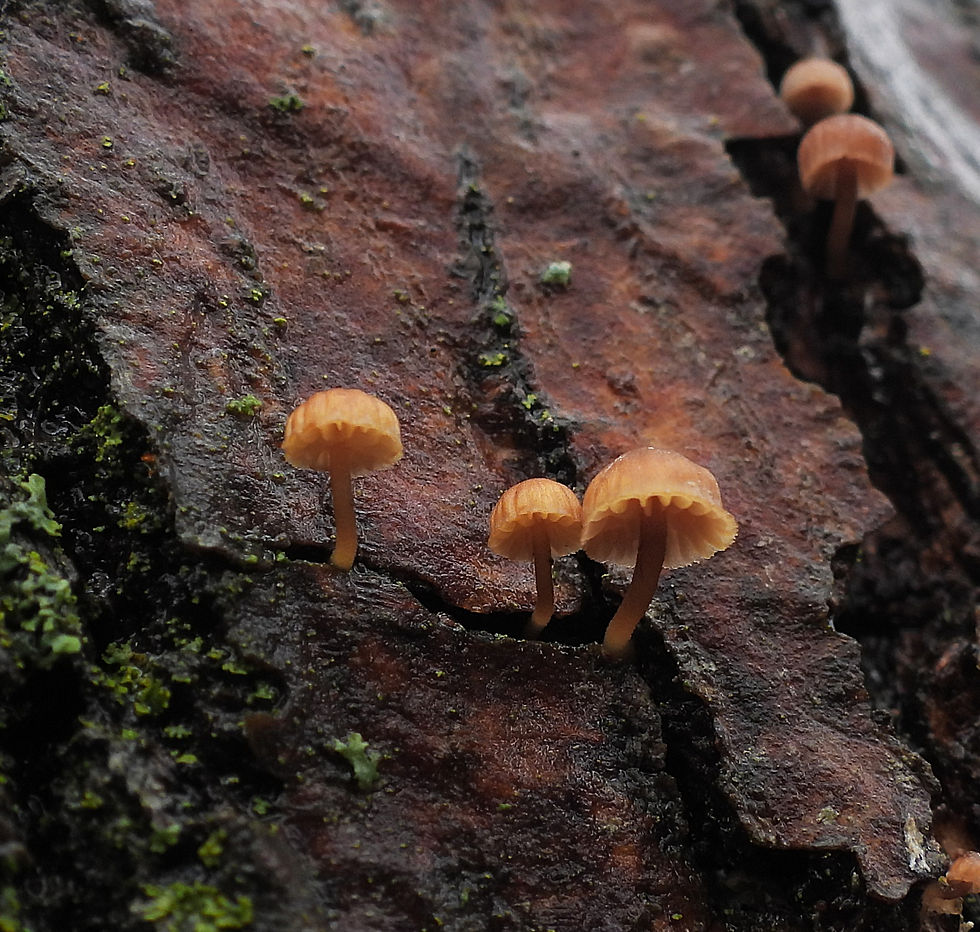
These mushrooms only appear when the environment is cool and wet. Very wet. Immediately after a rain is the level of wetness we’re talking about. When it dries out, hours after the rain has stopped, they may already start to shrivel. A couple days later they are nearly invisible little brown smudges of dried up stuff. The mushroom can reanimate when water comes again. More importantly, the fungus itself is still active.
The mushroom is not the fungus any more than an apple is an apple tree. What we see as a mushroom is the fruiting body, just a means of getting spores into the world. The real action, depending upon your definitions of “real” and “action,” is happening down in the crevices of the bark. The hyphae, microscopic filaments that are the nutrient-gathering organ of the fungus, are down there in the literal trenches. Sort of like roots, but not roots. If you pull a cotton ball apart and stretch it out, that’s what hyphae look like if you teased them out of whatever they’re consuming and put them under a scope.

In the case of the Bark Mycena, the hyphae are consuming old pieces of bark and other organic matter that’s gotten into the crevices of the trunk. Who knows what all’s in there? A crab spider might have laid eggs that died. A Brown Creeper might have unloaded its waste that dribbled in there. It’s a hot mess of debris in those dark places, but for the most part, the Mycena is pulling nutrients from good old bark. It produces enzymes that break down cellulose and lignin, something you can’t do with your supposedly advanced gastrointestinal system, which is one of the reasons you don’t eat a lot of bark.

Mycena doesn’t invade the living tissue of the tree, it’s just there for bark. The bark is thicker when older, as well as having more texture and crevices, which is why you’ll see these mushrooms only near the base of most trees and also primarily on rough-trunked trees like oaks. There’s a lot more bark material on a young oak than there is on this old serviceberry. That’s one of the reasons I was surprised to see them on this tree, and not on adjacent oaks.
Have I discovered a new species of Mycena that only inhabits mature serviceberries? Assuredly not, but the idea isn’t as fanciful as it may seem. There are species that specialize in madrone trees and others that are only found on the bark of Western Red Cedar. Another only appears in the fallen leaves of Beech trees. Fungi, and Mycena in particular, are not afraid of absurd specialization. Still, everything about this tells me it’s the good old Bark Mycena and some spores settled here years ago and said, “Yeah, this’ll do.”
I’m glad they did. Tiny mushrooms make me happy. How can you not smile, seeing these little things?

They’re so simple. It rains, they pop out and demand to be seen, though only one of a thousand humans passing by might notice them. The bark dries and the mushrooms vanish. The hyphae keep doing their thing.
They’re so complex. Enzymes tailored to deconstruct specific organic molecules are produced in flimsy, cottony threads. Enzymes that a hundred biochemists in a ten million dollar laboratory would struggle to synthesize. Producing mushrooms many times the bulk of the hyphae in a matter of minutes when the rain falls - structures of unimaginable intricacy carrying nothing less than the genetic material to launch a billion fungal colonies.

One day soon, or at least soon in the sense of a forest’s life, this serviceberry will exhaust its ability to cycle energy from sun, water, and soil. It will die and myriad fungi will return decades of accumulated matter to the forest. The Mycena were there first. The scouts. Getting the process started today while the tree still stands, feeding birds with its April berries every spring. Flecks of bark become mushrooms that shrivel hours after a rain and return to the soil. For a tree, decay begins long before death, and life continues long after the last leaf falls. Thanks to fungi, that is.
I’ll look for these mushrooms after the next rain, and every rain, until either I or the serviceberry succumb. Most times I pass, it will be dry and there won’t be a hint of evidence that anything is happening. Except I’ll know there is. Because I caught this festival of mushrooms on a rainy winter morning. I’ll know the fungus is hard at work in the dark recesses of the bark. Knowing that is enough. To know that and hold it dear is to know and love a forest.
Check out the various Mycena on iNaturalist!

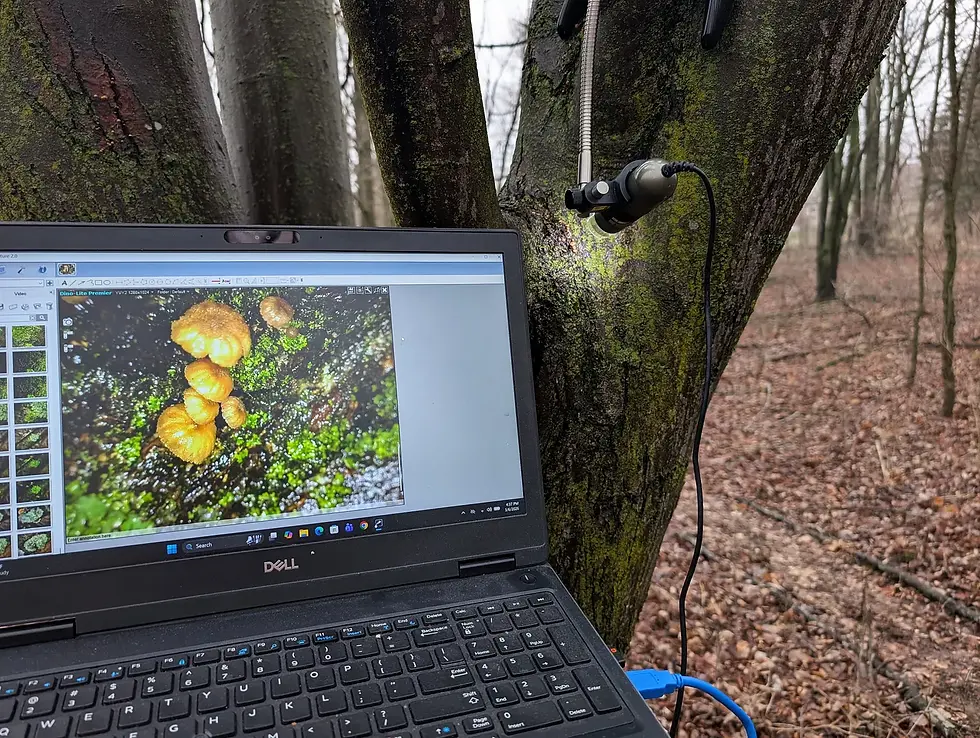
Bonus photos of how I took some of these shots in situ (in the wild without taking the subject somewhere else.) The Dino-Lite microscope is an amazing tool.

Want more mushrooms? Here’s a great newsletter to follow!


Comments