Blanding's Turtle
- Kirby Adams
- Mar 15
- 5 min read

Updated: Mar 16
I’ve seen some spectacular wildlife over the years, but the most shocking thing ever was an unexpected beaver. There is no good beaver habitat near my home. The three closest records are all 12 miles away, and at the time of my sighting the closest was 22 miles away. But there it was, standing on the edge of a ditch a mile down the road. We drove past and it plopped into the ditch and squeezed through a culvert under a driveway. That got me thinking, as surprise beavers will do, about just how far some animals will wander when seeking out fresh territory. It turns out some beavers will walk over 100 miles. I’ve seen a hummingbird from the Mexican desert on the shore of Lake Superior, but somehow that seems less impressive than a beaver migrating a hundred miles. Then there’s turtles.
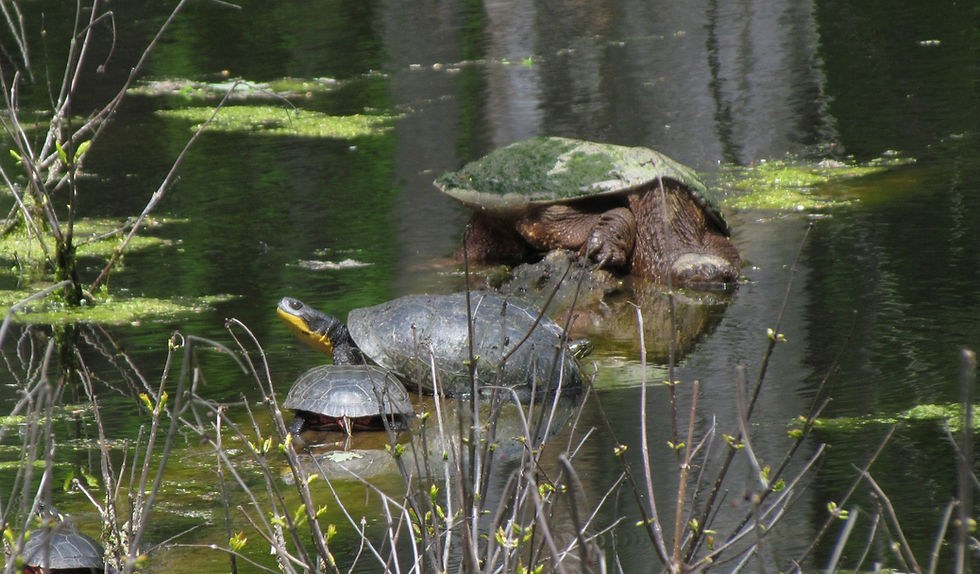
People think turtles on land are slow, and people are correct. You might be surprised by how fast a turtle could walk across your yard, but still, it’s hard to think of a terrestrial vertebrate that couldn’t beat a turtle in a 10 meter or 100 meter race. Probably some salamanders would struggle with that, but really they just need to train harder. What turtles lack in velocity they make up for in determination. Blanding’s Turtles (Emydoidea blandingii) are known to travel as much as two miles. I don’t know if that’s objectively any more shocking than my beaver story, but it brings me to another stunning sighting.
Several summers ago on a hot June day my wife texted me that there was a Blanding’s Turtle in the window well.

Three things made this difficult to believe.
Our house sits on a sloped upland with the nearest decent permanent wetland about a kilometer away. And after that, the next best habitat is over two miles away.
This window well is nestled in a corner of the house and garage in the most unlikely spot for rogue wildlife to appear.
Blanding’s Turtles are not at all common here. If you see a turtle on our road, 98% of the time it’s going to be a Painted Turtle or Snapping Turtle. Those are the farm pond and ditch turtles. Blanding’s are far more habitat sensitive and their numbers have dropped sharply as wetlands have been drained, roads filled with deadly vehicles have bisected their habitat, and suburban raccoons have proliferated. They’re listed as globally endangered by the IUCN. Michigan is one of their strongholds, but they’re not easy to find. They don’t just fall into window wells.

Still, my wife doesn’t make bold proclamations without surety. She has little natural history background, but I delivered a passionate hour-long speech about the glory of Blanding’s Turtles a year earlier when we saw some on a trail walk. And no other turtle has a bright yellow chin, so I was either being punked or there was actually one in the window.

Not only was it a Blanding’s, it was a behemoth. They take 15-20 years to reach sexual maturity (a bit longer than humans if you’re keeping score) and this one looked to be a mature adult female.

They’re tough to age, but she could have easily been 40 or 50 years old. That she could have ended her life trapped in that window well made me feel ill. Crushed on the road or “rescued” by a well meaning kid who wants a pet were other horrific risks to her. All things considered, that clumsy step into the window well might have been a life-saver. I released her to get on with her business, but she may have cemented her species as my favorite turtle.
![Global range of Blanding’s Turtle (Emydoidea blandingii). [iNaturalist data]](https://static.wixstatic.com/media/45cb82_4c8638bc9b384c269cd030dbd5d753e3~mv2.webp/v1/fill/w_967,h_451,al_c,q_85,enc_avif,quality_auto/45cb82_4c8638bc9b384c269cd030dbd5d753e3~mv2.webp)
With all due respect to William Blanding who discovered the specimens that led to the scientific description of the species, I’d rather see Emydoidea blandingii called the Great Lakes Turtle. That’s what it is, after all. The only other reptile as tightly tied to the Great Lakes basin is the Eastern Massasauga rattlesnake.

I may be biased as a denizen of the Great Lakes myself. There’s a disjunct population of Blanding’s on the Atlantic coast from Massachusetts to Maine, one in southern Nova Scotia (an area very similar to northern Great Lakes), and then the Nebraska sandhills, perhaps the area where their population is most stable. The southern part of the Niobrara River watershed in Nebraska has the benefit of very few roads, fewer raccoons, and very few people. Dr. Jeffrey Lang of the University of North Dakota has been studying the Nebraska Blanding’s off and on for a quarter century, and some Great Lakes and Mississippi River populations before that. He suspects the total regional population in Nebraska to be several hundred thousand and likely increasing. Given that news, I’ll concede that Sandhills Turtle might be a better name.

Roads, raccoons, and rascals are abundant throughout Blanding’s range here in Michigan, but the turtles are hanging on. Biologists at Shiawassee National Wildlife Refuge have spent years collecting eggs from females who were laying in unsurvivable nesting sites (hard gravel roads) and releasing the hatchlings back into the refuge. They’ve also experimented with “headstarting” the turtles by raising them until they were bigger and stronger than hatchlings and then releasing them. Headstarted turtles have shown remarkably good first winter survival. That’s the toughest time for a turtle that’s never seen a Michigan winter before. The releases that went into cattail stands with muskrat activity did a great job of finding muskrat dens for winter brumation (the reptile version of hibernation.)
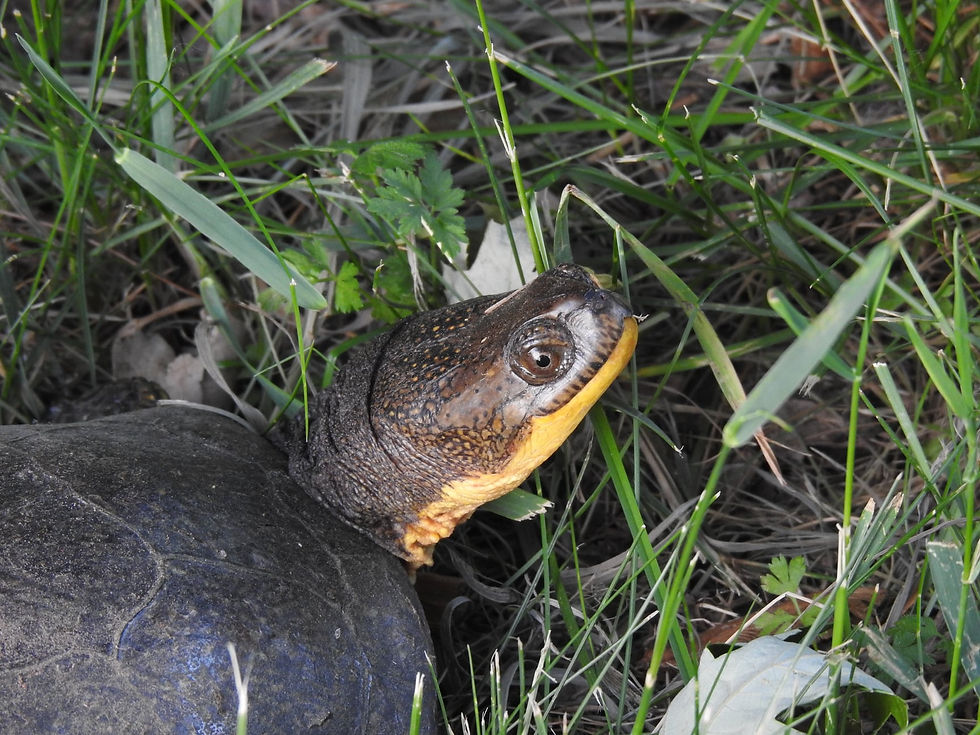
It’s been five years since that turtle appeared in our window. I’ve found three more in the immediate area since then. I like to think that particular one is still out there, though. You sometimes have a serendipitous encounter with an animal and you think about that individual years later. In most cases, you can safely presume they’re dead and gone, with their offspring ideally carrying on. But this lady could easily still be out there. She might be as old as I am and may outlive me. She could still be laying eggs after I’m pushing up daisies.
I hope so. That thought doesn’t bother me one bit.


Comments