
Tree Lungwort

More than a century ago, teams of miners would carry a canary or other small bird in a cage as they toiled in mineshafts far beneath the surface. With their small size and higher respiration, canaries would succumb to poisoning from carbon monoxide or other airborne toxins before the humans would even notice it. When the bird croaked, it was time to get out of the mine. The canary acted as a sentinel species, one that detects environmental hazards quicker and more acutely than humans. Technology has advanced to the point that we don’t need to subject captive animals to toxic conditions, but sentinels still stand guard, should we care to notice them.
Tree Lungwort (Lobaria pulmonaria) is a lichen, and like many lichens, it doesn’t handle air pollution well.

Wait, that bright green leafy thing is a lichen? Yeah, it is, and now is probably a good time to reckon with its scandalous lifestyle before we get back to its sentinel work.
Lichens, as you may know, are typically symbiotic relationships between a fungus and an alga. The alga makes carbohydrates from photosynthesis, and the fungus collects other nutrients from the air and substrate while also giving the alga somewhere to live. Some lichens are a fungus paired with cyanobacteria, which sometimes go by the misnomer “blue-green algae.” Cyanobacteria are not algae — they really are a bacteria. They are photosynthetic, but in a totally different kingdom than plants (which includes most algae). Cyanobacteria are notable for “fixing” nitrogen, a process by which they can convert nitrogen in the air into usable nitrogen compounds for a plant. (Roots of legumes like peas do this too, but that’s another story.)
Now we get to the Tree Lungwort, which is a symbiotic marriage of a fungus, an alga…..AND a cyanobacterium! It’s a ménage à trois happening right there on that tree trunk in front of you. They call that three-member situation a tripartite relationship, as opposed to the more common bipartite symbiosis. I warned you this would get weird. Lungwort has no shame. During dry periods it can get gray and crispy, but in a cool, damp woods, it’s out there letting its freak flag fly. Tree Lungwort is most conspicuous and at its greenest after rains and when the air is thick with moisture. You’ll find it almost exclusively on older, larger trees. Some of the colonies are decades old.

Many common lichens are crusty things on rocks or bark, sometimes looking like flat leaves glued to a surface or just a powdery clump. Others are more like moss or look like clusters of thread. Tree Lungwort, again, is totally different. It has big, green, lobed leaves that look more like a fern than anything else. At some point, someone who had cut open a lung or two decided that it looked like the tissue inside lungs. That’s where the name lungwort and the specific epithet pulmonaria (from the Latin pulmo, meaning lung) come from. There are other true plants called lungwort for similar reasons, but we’re just talking about the lichen here.
In North America, you will find Tree Lungwort across the eastern boreal and sub-boreal forests, and down through the higher elevations of the Appalachian Range. It’s also common in the wet forests of the Pacific Northwest and the Canadian Rockies. Where you will not find it is in areas where pollution is high.
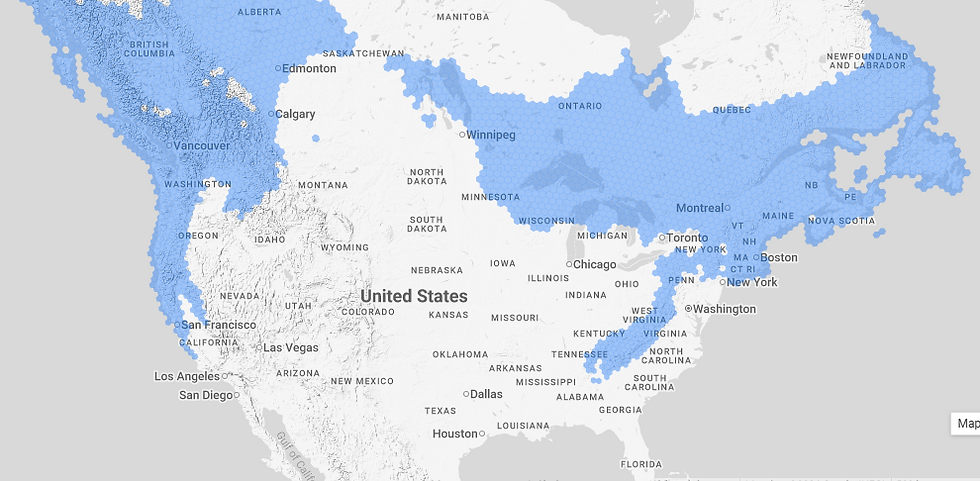

Tree Lungwort is the canary in the coal mine for toxins like sulfur dioxide (SO₂), which is ironically one of the principal air pollutants released from the combustion of coal. SO₂ produces acid rain, acidifies waterways, and wrecks human lungs. If it’s elevated in the air, lungwort will lose its chlorophyll and mostly fall apart long before any of that other stuff happens. It is quite literally an air-quality monitor.
[Excessive science musing warning! Skip this next paragraph if you’re already sick of the jargon up to this point.]
The cyanolichens, lichens that contain a cyanobacteria symbiont, are much more susceptible to SO₂ than other lichens that lack cyanobionts. You would think that the SO₂ sensitivity is related to the cyanobiont, and it may be, but we don’t really know. In the last few years, they’ve done genetic sequencing of Nostoc, the cyanobiont in Lobaria pulmonaria, and found a magnified set of genes dedicated to sulfur transport and assimilation.(1)So the Nostoc is set up to deal with sulfur compounds. Couple that with the evidence that SO₂ seems to derail photosynthesis (the realm of the photobiont) and not really interfere with nitrogen fixation (the cyanobiont’s job), and that leads one to think that the Nostoc isn’t at fault for L. pulmonaria being SO₂ sensitive. Stay tuned, I guess!
Gunawardana D, Wanigatunge RP, Wewalwela JJ, Vithanage M, Wijeyaratne C. Sulfur is in the Air: Cyanolichen Marriages and Pollution. Acta Biotheor. 2023 May 6;71(3):14. doi: 10.1007/s10441-023-09465-7. PMID: 37148405.
[End excessive science musing!]

Tree Lungworts are declining everywhere across their range. Logging of old-growth trees removes their habitat, and air pollution poisons the ones that remain. Lichens aren’t as charismatic as polar bears, condors, rainforests, and coral reefs. You won’t see a march of environmentalists carrying signs that say “Save the Tripartite Foliose Lichens!” I propose that you should care, perhaps as much or more than you care about a malnourished polar bear on an ice floe. Tree Lungworts are ancient in both evolutionary history and physical age. When you see them, you’re seeing something vital. You don’t have to believe sentinels are a product of a higher purpose to understand that we ought to pay attention to them.

We don’t live in a mine from which escape is possible. We are bound to Earth, and when the sentinels vanish, we’re next. Take time to think about that the next time you see Tree Lungwort. Better yet, think about that the next time you don’t see it where you’d normally expect to. Its absence should be a scream echoing through the northwoods.


Comments