
Six-spotted Tiger Beetle

If you live anywhere in the eastern United States other than peninsular Florida, you’re probably familiar with the Six-spotted Tiger Beetle. You may know it as the Zippy Green Beetle, Emerald Beetle, “those bright green bugs,” or a variety of other names. They land on patios, sidewalks, and driveways in the sun, disappearing in a flash as soon as you walk near them. In my youth in Pennsylvania and now in Michigan, they are one of the true signs of summer. The first one usually appears around the beginning of May and that signals the death of winter (usually).
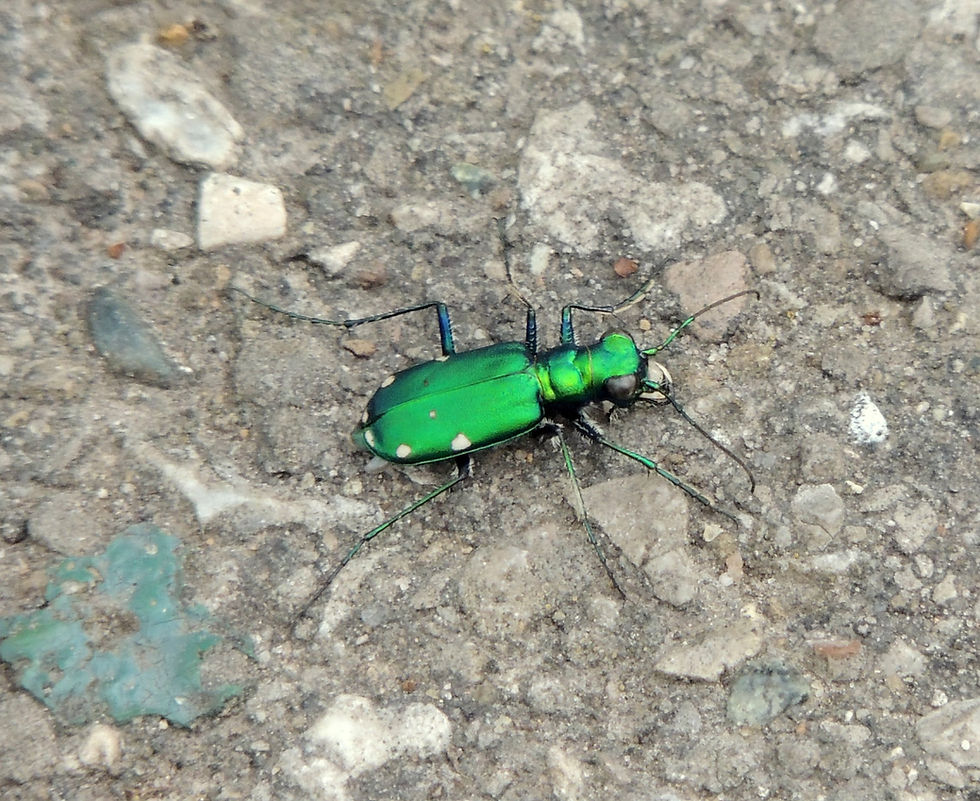
So what’s the story behind these screaming green sun worshippers? Other than their appearance, two things make them particularly interesting. They are ferocious, and there’s a reason they enjoy a concrete slab in the summer sun.

Let’s start with the ferocity. If you’re a small insect, tiger beetles in general are nightmares. The Six-spotted in particular adds a rather demonic look. They have bright white mandibles. On a beetle that already has eye-catching color, making the guillotine blade and serrated machete jaws gleaming white is a bit of overkill. But they back up the look with action. When they jump on something, it gets held tight, ripped to shreds, and crushed to pulp pretty quickly.

Six-spotteds are active hunters. There’s not much benefit to hiding when you look like that. The green is such an unnatural green, it still stands out against any kind of vegetation. And flashes of white are warning and distraction signals at every level of the animal kingdom, so those mandibles aren’t designed for stealth either. These beetles get their food by sheer speed and aggression. The speed part leads into the other interesting thing we’re going to discuss.
The most studied aspect of Cicindela sexguttata behavior and physiology is their thermoregulation – how they manage their body temperature. Pouncing on fast-moving insects and ripping them to pieces takes a lot of energy, and the beetles get a lot of that from rapidly heating themselves up. They’ll land in an exposed, sunny spot and warm up to about 92°F and then they’re ready to go. When you see them landing on surfaces that would burn the skin off your bare feet, they’re just getting poised to murder a fly or bug. It’s like seeing an archer pulling back the string on a bow.

Since we’re on the subject of speed and aggression, we should add a third fascinating topic about tiger beetles - their mating behavior. Males pursue females the same way they hunt, with speed. They heat up, chase them on foot, then pounce and latch on with their mandibles. Instead of decapitating the female, which would be counterproductive to procreation, the male pinches his mandibles into a crevice on the female’s thorax. Then he grabs ahold of her flanks with his front tarsi (feet) which have a pad of setae (hairs) designed to grip to smooth surfaces like the underside of a female tiger beetle. Those white pads are the easy way to sex a tiger beetle in the field if you can get a good enough look.


While the male is getting himself locked in place, the female goes full rodeo, bucking like a bull to jettison the male. All of this is happening at typical tiger beetle speed, which is to say you aren’t going to get a good look at this. If the male hangs on and successfully copulates, he’ll keep his grip for a while and the two of them will sit still. This is called post-copulatory mate guarding. He’s not protecting her from harm, he’s preventing other males from mating with her. The photos you see here are Six-spotted Tiger Beetles in this mate guarding behavior after copulation.

So there you have the story behind those zippy green bugs. If you never look at them the same way again, my work here was not in vain.

Six-spotted Tiger Beetle (Cicindela sexguttata) at



Comments