
Wood Frogs

Imagine that you are a world-renowned organ transplant surgeon. To relieve stress, your husband suggests a holiday in Manitoba, looking for amphibians. Your husband is obviously a wise man. More than a bit of winter’s snow is still on the ground, but large pools of water have collected in low spots throughout the sub-boreal forest. You hear a phalanx of ducks quacking in the distance, but you gradually come to realize the ducks are much closer, not to mention invisible. The quacking is coming from a nearby vernal pool. You stare at the rippling surface of the umber pond, mesmerized.
“What are you contemplating?” your husband asks.
“Liver transplants!” you respond, a bit too enthusiastically. Your companion seems annoyed that you can’t shed your job for just an hour, but he can’t see the knowing smile on your face.
The context for that scene will be explained in due time, but we’re going to start with the thesis that Wood Frogs are intrinsically wonderful.

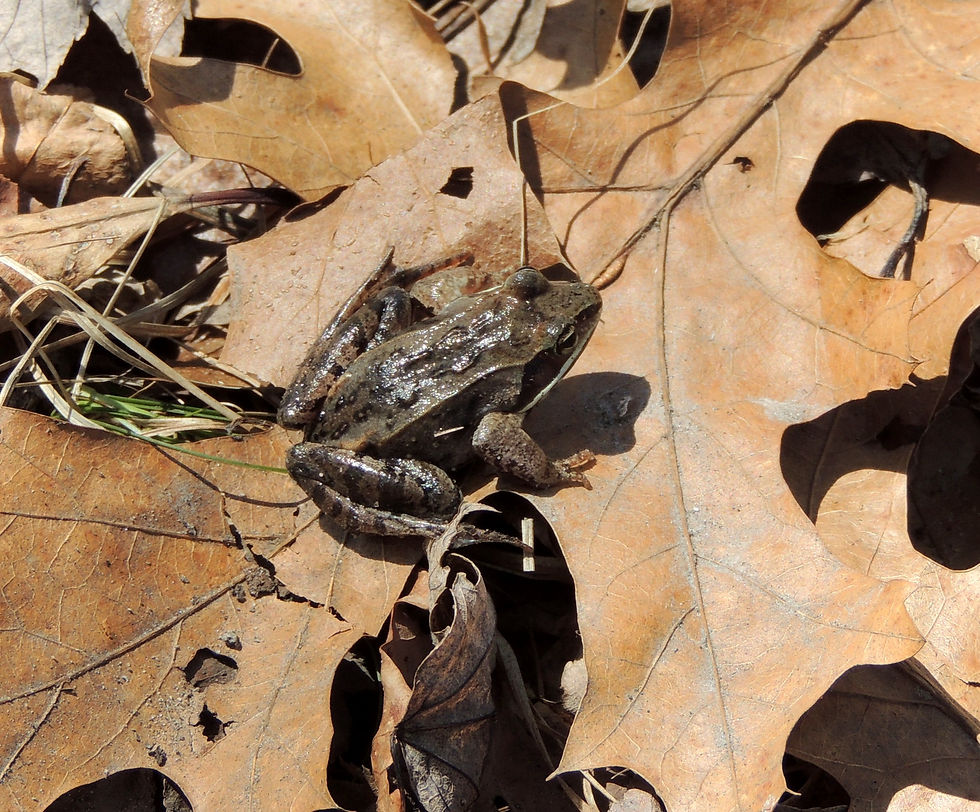
The Wood Frog (Lithobates sylvaticus formerly Rana sylvatica), with its duck-like call, is the consummate vernal pool denizen. I don’t say that simply because they consummate their sexual reproduction in pools, which they do, but because they refuse to do so anywhere else. They are obligate vernal pool breeders, meaning that if a springtime puddle isn’t available when the time comes, the frogs will not spawn. Snow melt and spring rains fill a low spot in the woods, Wood Frogs gather and spawn, eggs hatch, tadpoles feed, tadpoles develop legs and lungs, pool dries up as summer arrives. Rinse (literally) and repeat.
Vernal pools are common in the Great Lakes area, the northeastern US, central Appalachians, across forested Canada, and throughout most of Alaska. You would correctly presume that I also just described the range of the Wood Frog. Approach a transient pond in early spring anywhere across that range and you’ll hear the quacking orgy.

Summer in Alaska sounds delightful if you’re a frog. The insect explosion is a nirvanic feast. But isn’t interior Alaska frozen for a majority of the year? It is, as are the Wood Frogs. This is where these frogs show their inner honey badger - they just don’t give a crap. Most frogs that live in places where winter is cold go deep into mud at the bottom of permanent ponds and lakes, slowing down their bodily functions and brumating (hibernating) until it warms up. This is logical, because if the water in your body freezes, the tissue dies, and if enough tissue dies, you die.
The Wood Frog just crawls into a pile of leaves and freezes to death. Two hundred days later, the spring sun warms the pile of leaves, and the same frog stretches its limbs and heads off to a vernal pool for some serious mating activity. The same frog that had frozen to death? Yes, although we’re about to open a philosophical discourse on the nature of death, and we’re here to talk frogs. Let’s just say the Wood Frog has no detectable signs of life. No heartbeat, no circulation, no brain activity. Not just reduced levels - zero of any of that. Functionally dead.
It pulls this off with some remarkable tweaks of chemistry.

Tweaks of chemistry mean that either Walter White is fixin’ to blow up a drug dealer’s office or that we’re about to enter the really dry phase of this frog discussion. To keep it simple, Wood Frogs use a whole lot of glucose to prevent their actual cells from freezing. Enough glucose to give an entire small town of humans diabetes. Beyond being a quick energy source, glucose is a cryoprotectant - an insulator against freezing. Additionally, the frogs have a tweak in their SERCA, an enzyme, that allows cells to keep producing energy when they’re really cold and dehydrated. This was explored by researchers at Aarhus University in Denmark who published a paper with the perfectly intelligible title: “Low Temperature Molecular Adaptation of the Skeletal Muscle Sarco(endo)plasmic Reticulum Ca2+-ATPase1 (SERCA1) in the Wood Frog (Rana sylvatica).” That light reading is free to access, otherwise I think that effectively ends the chemistry discussion right here.

The upshot is that if you find a Wood Frog in January, you could plop it in to chill your margarita. This falls into the category of things that you shouldn’t do just because you can. All frogs have weird skin secretions, and while Wood Frogs aren’t known to be very harmful to humans, they do have chemicals that shrews find disgusting, so don’t do that kind of biochemical research on your own. Not to mention, it’s harmful to the frog. And we should address why you’re drinking margaritas in the middle of the woods in January.
And now we have arrived at liver transplants. One of the paramount challenges of organ transplantation is the preservation of a harvested organ in pristine condition for the hours it takes to get to the recipient and hooked back up to a blood and oxygen supply. Chilling the organ helps, but too much chilling destroys living tissue. Now you see why our surgeon was smiling at the vernal pool. Wood Frogs’ ability to freeze near-solid and emerge unharmed is a hot topic in medical research, particularly organ transplant science. Human livers kept near freezing can last 8 to 12 hours. What if you could actually freeze it and use it days or weeks later? No one is necessarily saying the frogs hold the key to such a breakthrough, or that such a thing would be possible, yet, but that is how research works.
Vernal pools and Wood Frogs don’t get much conservation attention. They don’t have the charisma of coral reefs and polar bears. Vernal pools are imperiled and there are conservation efforts, but they need all the help they can get. Having a frog that’s interesting to biomedical research being an obligate pool user doesn’t hurt the effort. Frog conservation lives off spare change. Organ transplant research has eight-figure research grants.

I propose that we make serious efforts to protect Wood Frogs and their vernal pool homes for a different reason. Just because.
No rational person is against advancements in human health, but sometimes we need to not bother to ask what the anthropocentric value of a frog or a pool is. Ask not what the frog can do for you, but what you can do for the frog. Seriously.

Can we say the Wood Frog has value simply because it is a Wood Frog? We can and we should. Not being a surgeon myself, I still stand in awe and reverence of a pond full of frogs. Not because they have value to me, but because they’re there.


Comments